
Showing posts with label Peter Sutton. Show all posts

Wednesday, 22 February 2012

Part Two of Two - A Delectable Lie, a Tree and a Way Forward: Multiculturalism and Aboriginal Policy Compared

As mentioned in part one, I see similarities between Salim Mansur's concerns about multiculturalism (as expressed in his book Delectable Lie) and my concerns about some aspects of current aboriginal policy in Canada.

In both cases, the government enacted legislation in order to gain support from the immigrant and aboriginal communities.  The officials involved wanted to appease those who felt Quebec was getting preferential treatment in constitutional discussions, e.g., those who believed Canada was more than two founding nations.  In addition, politicians wanted to get all sides on board so that constitutional negotiations could be finalized.

The evolutionary climate of the last 40 years of the 20th century gave legislators the idea that it was OK to tinker with liberalism so that societal changes could be accommodated.  But Mansur feels that caving in to the demands of special interest groups results in a weakening of the small l liberalism that is important for maintaining freedom and individual rights in a democratic society.

In fact, it is not just small l liberalism that is at stake, but the security of the country.  There are increasing reports that Islamist and/or pro-Palestinian/anti-Jewish forces are involved with aboriginal protests.

Pro-Palestinian/Anti-Jewish Groups and the Six Nations Occupiers at Caledonia

One of the most glaring examples of this is the nearly six-year occupation by Six Nations militants of the former Douglas Creek Estates (DCE) at Caledonia, Ontario.  You can read my "David Peterson and the Caledonia Crisis" post for more information about this crisis.

Caledonia activist Gary McHale said "when the occupation of DCE first started five Palestinian groups helped finance the occupation, and a Palestinian flag was raised on DCE. . .Since then anti-Israel protesters were seen at DCE. . .At McMaster [University] the same protesters on DCE are organizing Six Nations/Palestinian struggle events."

You can read McHale's February 1, 2012 article about this at the following link.

As McHale explains in the article, some members of the Jewish community have been following this issue with deep concern.  In fact, representatives of the Hamilton-based Never Again Group, which defends Israel and fights anti-Semitism, have been present at events organized by the Caledonia activists.

"Ending Race-Based Policing:  The Caledonia Act"

On February 9, 2012, Toby Barrett, the MPP for Haldimand County (which includes Caledonia), provided the Queen's Park Media Studio for the following people to make presentations about the topic "Ending Race-Based Policing:  The Caledonia Act."

1.   Gary McHale, Canadian Advocates for Charter Equality (CANACE)
2.   Stuart Laughton, Never Again Group
3.   Mary Lou Ambrogio, International Free Press Society-Canada vice-president
4.   Kristin Kaye, Caledonia-based Regional News reporter

You can find out more about the event and presentations at the following links on Mark Vandermaas's Voice of Canada website:

http://voiceofcanada.wordpress.com/2012/02/13/queens-park-news-conference-ngos-stand-with-caledonia-activists-for-release-of-caledonia-act-recommendations/

http://voiceofcanada.wordpress.com/2012/02/13/stuart-laughton-never-again-group-speech-at-caledonia-act-news-conference-individuals-are-the-ultimate-minorities/

http://voiceofcanada.wordpress.com/2012/02/13/mary-lou-ambrogio-international-free-press-society-connects-the-dots-wspeech-at-queens-park-caledonia-act-news-conference/

As Laughton says:
I want to stress that my group has made no opposition to the Natives who make land claims: we only protest the violent manner in which the claims to the Caledonia property were made and the racially skewed responses of the Ontario government. . .Will our next premier instruct police not to enter predominantly Muslim areas of our major cities, and allow microstates governed by Islamic Sharia law to flourish there? . .We also have to consider the effect that racially biased policing has on those Native Canadians, Tamils, Muslims, and others who ask for no special favours and want nothing to do with the more militant members of their community.  Who speaks for them? . .Our citizenry consists of millions and millions and millions of individuals and those INDIVIDUALS are the ultimate minorities.  Each of us has to be treated impartially before the law.
I completely agree with Laughton.  I am generally very supportive of the need by aboriginals to lobby for their rights, and to receive just compensation with regards to property, social justice, and other issues of concern.  But the events at Caledonia, in particular, have made me realize that the process of aboriginals lobbying for their rights can easily get sidetracked by those, like pro-Palestinian/anti-Jewish forces, who have an agenda that may not be in keeping with what all the people at Six Nations want.

Furthermore, what about the third of aboriginals who do not identify themselves as such in the federal census?  Do they share the views of the Six Nations occupiers and their supporters?  See my "Canadian Aboriginal Integration is Better than Assimilation or Parallelism" post for more information about this, and some related information.

Protecting the Rights of Individuals

One of the tests Mansur recommends for determining if a culture is of equal merit and deserves equal respect, is to see how the culture protects individuals (you can find a discussion of this in part one).  The bottom line is, how well is the Ontario government upholding the rights of the Caledonia residents, and, indeed, the rights of the Six Nations residents who are not participating in the occupation?

"Caring Measures" More Important than Attaining "Stratospheric Rights"

Australian anthropologist and linguist, Peter Sutton, has more than 40 years experience with the Aborigines in Australia.  His book, The Politics of Suffering: Indigenous Australia and the end of the liberal consensus (2009, 2011), is filled with many insights that I share.  Marcia Langton, the Aborigine scholar who penned a foreword for the book, also echoes his concerns.

Sutton complains that too many politicians, lawyers, and activists insist that Aborigines will not be truly happy and fulfilled until all outstanding issues, such as social justice, treaty and reconciliation, have been met.  He responds with ". . .[t]his unscientific mumbo jumbo beggars belief. . .Caring measures. . .rather than documentary measures based on increasingly stratospheric rights. . .lie at the effective end of realistic processes of improvement."

I do not know if Sutton is aware of the Caledonia situation, or if he has read and agrees with the concerns expressed in Mansur's book, Delectable Lie.  Therefore, I do not want to imply that he shares the opinions expressed in this post.  His words, nevertheless, resonate with me in terms of what I see is wrong, not only at Caledonia, but also what I often find is counterproductive regarding aboriginal policy development.

"Caring Measures" We Can Learn from the Six Nations Occupiers' Dog

CANACE videographer, Jeff Parkinson, took this footage, entitled "CANACE attacked on DCE," at a February 18, 2012 hostile encounter between the Six Nations occupiers and non-native residents who were objecting to the occupation.

http://www.youtube.com/CanacehD

As you can see, there was a lot of swearing and shouting and violence.

But photographer David Strutt was there, and was able to capture a more positive moment.

http://voiceofcanada.wordpress.com/2012/02/22/david-strutt-photos-capture-caledonia-8-history-on-douglas-creek-estates-in-caledonia/

This was when the Six Nations occupiers' dog welcomed Gary McHale.  Vandermaas said: "[f]or this one moment all the hostility evaporated.  David saw that the dog didn't understand hate; it didn't judge us [Caledonia activists] by the DNA running in our blood beneath our white skin.  It just saw a friend.  And David saw hope."

I think this dog can teach us all a few things about hope--and "caring measures."

A Way Forward

Here is a photo I took last summer, of a path in a park near my home:
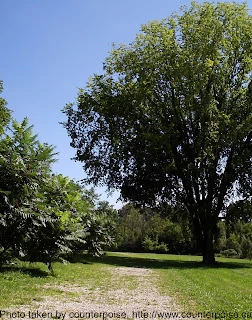

It reminds me of the fact there is always a chance we will pull ourselves out of this mess, that we will find a way forward to a more peaceful solution.

Friday, 27 May 2011

Violence Against Aboriginal Women

On March 25, 2011, the Canadian House of Commons all-party Standing Committee on the Status of Women tabled Interim Report: Call Into the Night: An Overview of Violence Against Aboriginal Women (the final report should be ready by the fall of 2011).  Hedy Fry (Liberal, B.C.) is the chair of this committee, and Irene Mathyssen (NDP, Ontario) and Tilly O'Neill-Gordon (Conservative, New Brunswick) are the vice-chairs.  The committee traversed the country between April 2010 and February 2011, meeting with reserve, rural and urban stakeholders.  More than 150 witnesses provided testimony.  In her press release regarding the interim report, Fry said the problem was getting worse.

A Statistics Canada report, released May 17, 2011, provides chilling validation of the committee's findings.  In Violent Victimization of Aboriginal Women in the Canadian Provinces, 2009, author Shannon Brennan noted that nearly 67,000 aboriginal women reported they had experienced violence in the previous 12 months.  This represents 47% of aboriginal women, 15 years and older, in the provinces.  (The territories (Yukon, Northwest Territories and Nunavut) were not included in this study.)  Aboriginal women were nearly three times as likely to self-report these incidents, as compared to non-aboriginal women.  Males acting alone were primarily responsible for the altercations.

I was saddened to learn the situation remained as bad as this.  More than 30 years ago, I worked in a native organization in which most of the aboriginal women on staff were getting beaten up on a regular basis.  I strongly advised one of my co-workers to leave her abusive male partner, which she eventually did.  However she had to live with a permanent reminder of the failed relationship:  a skeletal disfigurement.

Later I worked in another aboriginal organization in another part of the country.  Aboriginal male partners were victimizing both of my native female co-workers.  The husband of one of them would do things like lock her out of the house in sub-zero weather, and refuse to let her back in for more than an hour--even though she was only wearing her undergarments.  She was under so much strain from the abuse that she would sometimes break down crying at her desk.  I pleaded with her to leave him, but she stayed with him for about another five years.  Fortunately, the other younger co-worker ended her relationship much sooner.

I also learned first hand about the violent rages of some aboriginal men when I was in a relationship with one more than 25 years ago.  I broke off contact with him when he tried to cut off my hand with a knife.  Despite my refusal to have anything more to do with him, he found ways to continue to make my life miserable, e.g., stalking me and manipulating my co-workers.  I did not truly feel safe until I left the area entirely about two years later.  Yes, I know that non-aboriginal men can also be violent, but in my case the only relationship I had that turned violent was with an aboriginal male.  However, I want to stress that I know many aboriginal men are not and have never been violent.

Why does the violence continue to get worse?  I would argue that the constant blaming of forces such as colonization and the residential schools has not helped move the dialogue forward.  Yet many witnesses who presented evidence to the Status of Women committee included these two factors among the main causes.

Don't get me wrong.  I know that colonization and the residential schools have contributed substantially to the dysfunction, but I maintain it is completely unrealistic for some people to insist that all aboriginal misfortune only started when non-aboriginals arrived on this continent.  Numerous missionary and explorer reports indicate that some aboriginal tribes treated their women well, but others did not.  Surely at least some of the negative reports contain a modicum of truth.

There is a Wikipedia article entitled "Gender roles in First Nations and Native American tribes."  I cannot vouch for the accuracy of all of this article, but a lot of it rings true based on what I've read elsewhere or experienced.  If you look at this article, you will see that there were many variations in practice regarding the role of women.  I have no problem with some aboriginals pointing out that gender equality existed among their ancestors, and I think it is fabulous that they have affirmed and retained this practice.  But it is not accurate to give the impression that all aboriginals historically treated their women well.

In 2007, Australian writer Louis Nowra's Bad Dreaming was published.  I have not read the book, but I have read a March 7, 2007 article he wrote for The Australian ("Culture of denial"), that covers some of the same material as his book.  Nowra contends that some of the violence does result from traditional practices that are best forgotten.  Australian anthropologist and linguist Peter Sutton came to the same conclusion in his book The Politics of Suffering (2009).  Some researchers have noted there are similarities between the Australian and Canadian experiences, and I believe this to be the case as well.

Despite my reservations about some aspects of the Status of Women interim report, I do think it contains some important findings that will help move the dialogue in the right direction.  These include:
  • A coordinated, holistic approach is required that will help aboriginal men break the abusive cycle
  • Aboriginal men need support to overcome addictions, mental health and other issues that contribute to their violent behaviour.  Peer support groups initiated and run by aboriginal men have proven to be effective in this regard
A holistic approach involves looking at all sides of the story, including factors that may have contributed to aboriginal dysfunction pre-contact.  It also involves getting to the root causes of why some aboriginal men become violent.  I believe peer support groups can be an excellent way to help men break the abusive cycle, as long as the leaders of these groups do not advocate hatred or violence towards non-aboriginals, and bad medicine is not practised.

Saturday, 14 May 2011

Clans and Tribes in the 21st Century

The anthropological definition for "clan" is "a group of people all descended from a common ancestor, in fact or belief" (Wiktionary, January 4, 2011).

The anthropological definition for "tribe" is "a society larger than a band but smaller than a state" (Wiktionary, April 22, 2011).
  
Thesauruses often list "clan" and "tribe" as synonyms of each other.

My maternal Scottish Highlander ancestors moved to Upper Canada in the 1850s. They experienced many hardships before they came here, none of which I would want to experience. I also have no desire to reignite the clan feuds that they eventually discarded in the New World. I am proud of their many outstanding qualities and accomplishments, but I see my lifestyle as constantly growing and evolving, not remaining static in the 19th century.

Nevertheless, I enjoy hearing stories about the different clans that existed among my relatives, and the symbols and tartans associated with them. I also believe that my interest in this helps me more fully appreciate why tribal systems are still placed in high regard by many aboriginal people in Canada.

Without question, Canadian aboriginals have often suffered a painful history, marred by the shameful legacy of the residential schools (although the schools were not all bad, but that's another story). For many years, I worked in aboriginal organizations, and witnessed first hand the difficulties residential school survivors faced because of the loss of their culture. In fact, I helped natives preserve their culture and tribal systems. However, I became increasingly concerned that they were preserving aspects of their culture that I thought they were better off discarding.

I felt the situation went from bad to worse when aboriginal rights were entrenched in the Canadian Constitution in the early 1980s. Entrenchment seemed to give some natives and their supporters the permission to believe that the aboriginal approach should always take precedence--even if there were better alternatives available. If I had known then what I know now, I would have departed from the aboriginal scene at that time. Instead, I remained involved up until the mid-2000s. I had many positive experiences with aboriginals throughout this period, but I felt these experiences were often superficial in nature. This was because I sensed they primarily regarded me as a political tool to help them get where they wanted to be.

It seems to me that some natives have overreacted to the loss of their culture by insisting that every aspect needs to be preserved. Don't get me wrong--many aboriginal practices are absolutely worth preserving--my home is filled with aboriginal art, music and literature that I treasure. But I now realize I was being forced into buying into the argument that all aboriginal cultural practices need to be maintained forever, and any questioning of this was usually labelled as racist.

What I experienced was cultural relativism. This principle contends that an individual's beliefs and customs should be viewed through the lens of that person's own culture. In other words, I was being forced to distrust my gut instinct that some aspects of the process did not result in positive outcomes. Unfortunately, far too many administrators in universities, churches, politics, media and unions have bought into the notion that cultural relativism is the route to go. It most definitely is not.

Just as I do not think it is a good idea for me to reignite the clan warfare of my Scottish ancestors, I also do not think that certain aboriginal tribal customs, such as bad medicine, should be preserved. There are many positive aspects to aboriginal spiritual practices, but bad medicine causes illness or bad luck to befall unsuspecting victims. It has been used on me with devastating consequences. In his book, Bad Medicine (2010), retired Alberta judge John Reilly recounts his own harrowing experiences with this affliction. Although I do not agree with some of the conclusions that Reilly comes to in his book, I am eternally grateful to him for getting his account published.

Australian anthropologist and linguist Peter Sutton also expresses concerns about bad medicine (he calls it sorcery) in his book The Politics of Suffering (2009). Sutton worked for more than 40 years among the Australian Aborigines, and has come to many of the same conclusions as I have. He laboured long and hard to help Aborigines preserve their culture, but became disillusioned when he saw that welfare dependence and substance abuse were leading to gross dysfunction in many of the outbacks. Aborigine scholar Marcia Langton wrote the foreword to Sutton's book and shares many of his concerns.

All cultures evolve and grow over time. Practices that are deemed counterproductive are discarded in favour of more effective ones. Although it is certainly understandable that many natives want to preserve aspects of their culture that they have lost over the years, I think they should carefully examine whether all of these practices are worth preserving. I contend that some aboriginal leaders would be better off concentrating on what will help their people move forward into the 21st century, rather than clinging to methods and ways that may be holding them back--and that may be causing unnecessary friction with non-aboriginals.