Showing posts with label Calvin Helin. Show all posts

Tuesday, 10 February 2015

A Review of Calvin Helin's Dances With Spirits: Ancient Wisdom for a Modern World

Disclaimer: My references to the writings of other people--both indigenous and non-indigenous--do not in any way imply that they share my views on this matter.  The opinions expressed here are my own, and do not necessarily reflect the views of my family, friends or associates.

Note:  The photos included with this post were taken by me.  The turtle artwork is by my mother, Jay Peterson (1920-1976).  Although none of these images have any direct connection with the material being discussed, Helin stresses, in Dances With Spirits, that "we are inseparable from nature."  My regular walks through my neighbourhood remind me of this.

Calvin Helin is a "member of the Tsimshian Nation," and is originally from the community of Lax Kw'alaams, which is on the Northwest coast of the province of British Columbia, in Canada.  Now he lives in Vancouver, which is a city in the southern part of the same province.  He is "the son of a hereditary chief," and an "entrepreneur, lawyer and best-selling author."

His book, Dances With Spirits: Ancient Wisdom for a Modern World (2014), "guides readers in applying ancient wisdom for a better understanding of today's complex modern world.  Millions crave spiritual fulfillment in a time of broken social relations.  Yet most are confused as to why their deepest yearnings for meaning and a kinder, gentler way of life are becoming more distant. . ."
". . .We live in a skewed society, focused on technology and money.  Through understanding our true nature, a better existence can be created."

Before I start my Dances With Spirits review, I will briefly discuss two of Helin's other books, which I have also read.
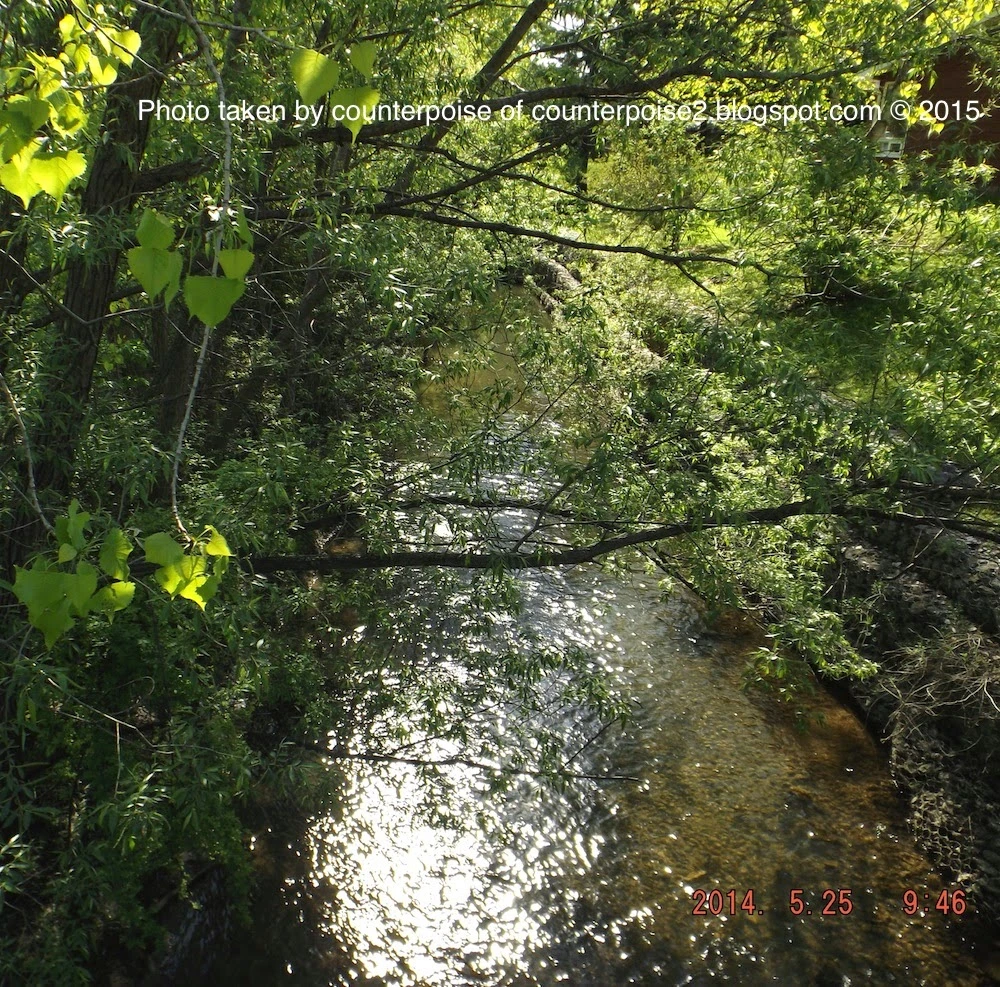
View from bridge, London, Ontario, May 25, 2014
A.          Dances With Dependency: Indigenous Success Through Self-Reliance (2006)

In Dances With Dependency, Helin argues that "[t]he current governance system is not only antiquated, but politically disempowers a substantial portion of the indigenous population, concentrates power and financial resources in the hands of a few elites, provides for painfully poor political and financial accountability and transparency, and continues to encourage a culture of dependency" (259-260).  He concludes that "simply throwing money at the problem will never lead to a long-term solution and may actually be exacerbating existing struggles.  Aboriginal people need a new generation of ethical leadership. . .with the courage to take the real action necessary for a brighter future" (265).

When I read this book in 2007, I was happy to learn that an aboriginal person shared my (non-aboriginal) view that the current "system" sometimes does more harm than good.  I was also pleased that he stressed the importance of self-reliance.

I assumed that, because he is an indigenous person, he probably had no trouble getting the book published.  So I was surprised to learn, in 2011, that he got 32 rejection letters for his Dances With Dependency manuscript.  Publishers told him they thought the aboriginal leadership would be offended because he "touched on reserve corruption."  Consequently, he borrowed $100,000 and published it himself.  He said in a 2010 interview that the majority of people who purchased the book were "grassroots" indigenous people.  When asked what the aboriginal leaders thought of his ideas, he responded that some shared his concerns, but others "wished he was at the bottom of a lake."  Regardless, the book is a bestseller seven times over.

In some of the previous posts on this blog, I have spoken about the different ways I became disillusioned with the aboriginal situation, and the fact that, since about the mid-2000s, I have primarily been on the outside looking in.

Fortunately, there are a growing number of aboriginals, like Helin, who are striving to not only improve the situation for their people, but also to help educate the non-aboriginal population about how we can all constructively move forward.  I always enjoy reading the stories of these courageous reformers.  I know from personal experience that it is hard for anyone to question the "elites" and the "system," so I recognize how brave they are.

Naturalized area in London, Ontario, September 19, 2014
B.          The Empowerment Mindset: Success Through Self-Knowledge (2012)

The target audience for Dances With Dependency was the aboriginal population.  But The Empowerment Mindset is addressed to everyone, regardless of race.  Helin's travels through life made him realize that "negative emotions and toxic thoughts" were holding back not only aboriginal, but also non-aboriginal, people.  In this book, he provides recommendations to help people find "constructive and fulfilling ways to attain success and happiness" (15).  He lists 10 "Laws of Empowerment" such as the importance of "hard work and sustained effort," and the need to adhere to a "strategic plan."

This book helped me to counter my own "mental and emotional sabotage" and to become more focussed on fulfilling my goals.

C.          Dances With Spirits: Ancient Wisdom for a Modern World (2014)

Dances With Spirits, like The Empowerment Mindset, is written for everyone.  The book helped me understand better why historically and currently some indigenous people are reluctant to assimilate into mainstream society.  Although Helin acknowledges that many aspects of mainstream thought can be positive, he feels there needs to be more balance and perspective.

The book is divided into three parts, which I will discuss below.  However, I have only included topics from each part that are particularly interesting to me, so it is not an exhaustive compilation.  After each topic, I have included "personal observations" as to how the topic relates to me.

C.1        Part I - When Myths Make a Mess

This part of the book "examines the structure of our current economic model and its economic, social, psychological, and spiritual impacts" (xxv).

C.1.1      Vicious Cycle of Consumption

Helin argues that advertising and marketing make people think "the only route to happiness is to consume ever more stuff" (9).  He says the Gross Domestic Product (GDP) "is deeply flawed because it is based on consumption by the population, rather than a broad range of aspects that reflect national well-being" (10).

Personal observations: My father, Charles T. Peterson (1913-2007), frequently warned me and others that our possessions could kill us.  As my first cousin's partner, Jim McClocklin, said at my father's funeral: "Uncle Chuck knew that life was not about things--life is about developing relationships and making memories."

The older I get, the more I understand what my father meant.  When I see advertising that urges me to hurry up and buy something, I ask myself whether I really need whatever it is.  Often the answer is I do not.

C.1.2      When Debt Leads to Slavery

Helin cites statistics regarding the alarming level of debt in the United States.  He contends we need to "do more with less" (31-34).

Personal observations: The same is true on this side of the border.  According to an analysis by the McKinsey Global Institute, Canada, among other countries, now has a greater household debt load than what existed at the height of the "credit bubble" in the United States and the United Kingdom.  Canadian debt increased to 162.6 per cent in the third quarter of 2014.  The study found that Canada is one of the countries most at risk of foreclosures and bankruptcies.

I have a hard time understanding why so many people take the plunge into debt, just because they want to "keep up with the Joneses." 

C.2        Part II - Veils to Vision

This part "discusses aspects of a vision for a new economic model that better addresses our social and spiritual well-being as well as our economic needs" (xxv-xxvi).
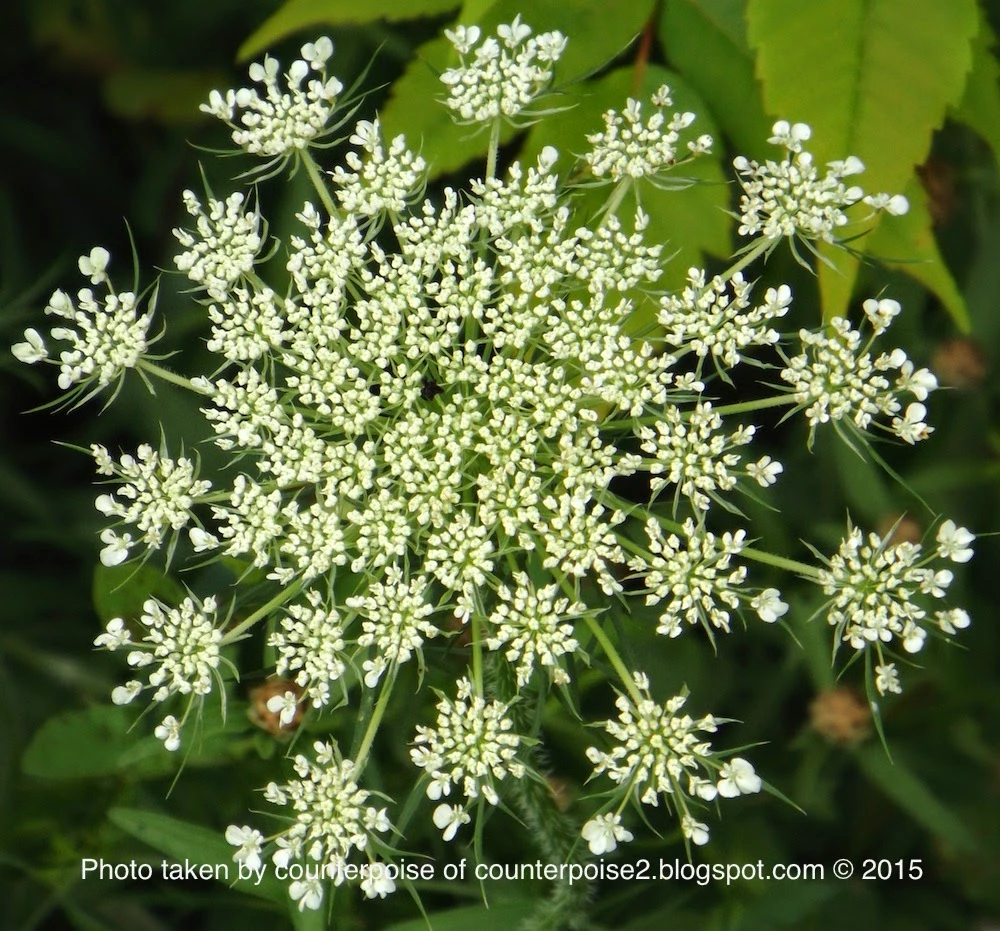
Wildflower, London, Ontario, July 15, 2014
C.2.1     The Technology Trap

Helin provides compelling arguments why technology, if not used wisely, can contribute to a whole host of problems.  For example:

• A study showed that students disconnected from their digital devices, for even a period as short as 24 hours, developed withdrawal symptoms similar to those of substance abusers.

• People are losing touch with the natural world and with each other because they are so immersed in the digital world (71-76).

Personal observations: What I find particularly disturbing about the "technology trap" is it can cause people to risk their own lives and those of others.  More than five years ago, the province of Ontario, in Canada, banned the use of portable device assistants behind the wheel.  And last year, the fine for breaking the law went up to $1,000.  Yet in 2014, police in London, Ontario laid 2,187 charges in this regard--close to double the number from three years ago.

C.2.2      Funnel Vision

Helin uses the phrase "funnel vision" to describe the tendency of Western cultures to "judge technologically poor societies as inferior."  This approach blinds many Westerners from seeing the cultural and spiritual strengths that frequently exist in societies other than their own.  This lack of recognition and support has caused many ways of life, including indigenous, to be eroded and, in some cases, to die off completely (81-84).

Personal observations: My family home was known as the "United Nations" because people of many different backgrounds passed through our doors.  So I grew up learning about the diversity of world views.

My mother, Jay Peterson, initially got involved with aboriginal issues in 1958.  From about 1969 until her passing in 1976, she devoted a large percentage of her time to helping educate people about the indigenous situation.  For instance, she taught a Native Studies course at Fanshawe College in London, Ontario.  Aboriginal people were frequently guest lecturers at this course.

I have some of the materials from her Fanshawe College course, including a one-pager entitled "Ways of Wisdom."  Twenty-one aboriginals from different tribes across the country helped my mother assemble this document.  It includes 11 observations, such as native people "were more interested in BEING than BECOMING."

My mother's relationship with aboriginal people led to my getting connected to the "cause."  From 1975 to 1987, I worked primarily in native organizations in Southern and Northern Ontario and the Northwest Territories.  But, as explained earlier in this post, I have mainly been on the outside looking in for about the past 10 years.

My mother's indigenous experiences spanned an 18-year period, but mine have lasted for more than 55 years.  Although I share her view that non-aboriginal people need to be better informed about the history and heritage of indigenous people, my approach is quite different from hers in other respects.  If you want to know more about my opinion on this, you can check out my other posts on this blog.
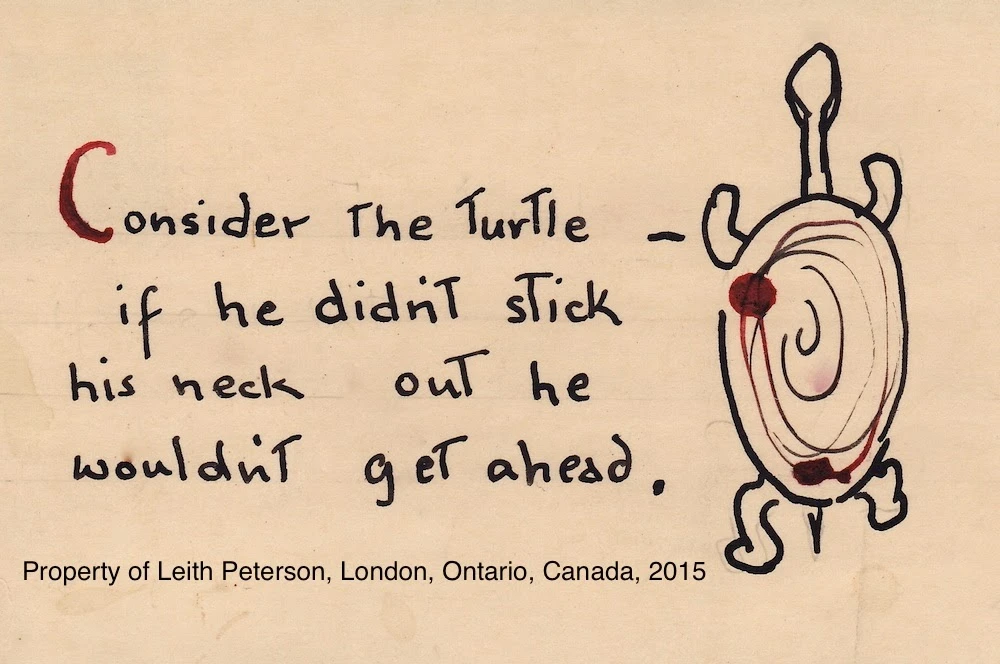
Artwork by Jay Peterson, ca. 1964-1974
C.          Part III - Creating Harmony

This final part "explores how we can incorporate the knowledge of past societies into a vision for a new economic model that can lead to a more holistic well-being that includes our social and spiritual dimensions" (xxvi).

C.3.1       A New Definition of Wealth and Progress

Helin contends a new international standard needs to be developed.  This standard would include making adjustments to the Gross Domestic Product (GDP) so it takes into account factors such as environmental sustainability and individual and government debts.  Quality of life, education levels, responsible governance and other measures can then be incorporated in (105-110).

Personal observations: Because of reading this book, I have become more aware of how much media commentary revolves around the GDP as a measurement of the country's health.  I agree with Helin that we need to adjust the measurements for this.

C.3.2        Finding Common Ground

It was refreshing to read Helin's arguments for why all people on this planet need to find "common ground."  It was even more refreshing to read his acknowledgement that we all need to move beyond the various intolerances that have emerged in our respective cultures, and try to work together for the best of all.

This is my favourite quote in the book:

As long as the views of one group are not harming another, we should tolerate others in the spirit of respect, cooperation and goodwill, recognizing that we are not diminished by differences as a species, but are ultimately strengthened by them.  Instead of promoting hate and suspicion about each other, we need to promote tolerance and understanding (123).

Personal observations:  These are what I think the implications are for aboriginal policy.  I contend there are three major positions: parallelist, integrationist and assimilationist.

Alan Cairns was the first to use the term parallelism, which he described as "Aboriginal and non-Aboriginal communities travelling side by side, coexisting but not getting in each other's way."  But Cairns is not a proponent of the term that he coined.  The Royal Commission on Aboriginal People (1996) advocated parallelism, that is, forming a third order of government separate from non-aboriginal society.

Integrationists, on the other hand, believe that a total separation of the cultures is not necessary or warranted.  However, there are many variations of this view.

Assimilationists prefer that aboriginals become part of mainstream society.  About a third of Canadian aboriginals have chosen this route, and do not identify themselves as such in the federal census.

I do not have any problem with aboriginals maintaining their culture and governance models, as long as they are also willing to remain part of the Canadian state.  I also contend that those aspects of aboriginal culture that may be harmful to any race should not be retained.  So I see my views in the integrationist category.

My impression, after reading three of Helin's books, is that his views also fall into the integrationist slot.  I think this approach is the best route forward for all Canadians.
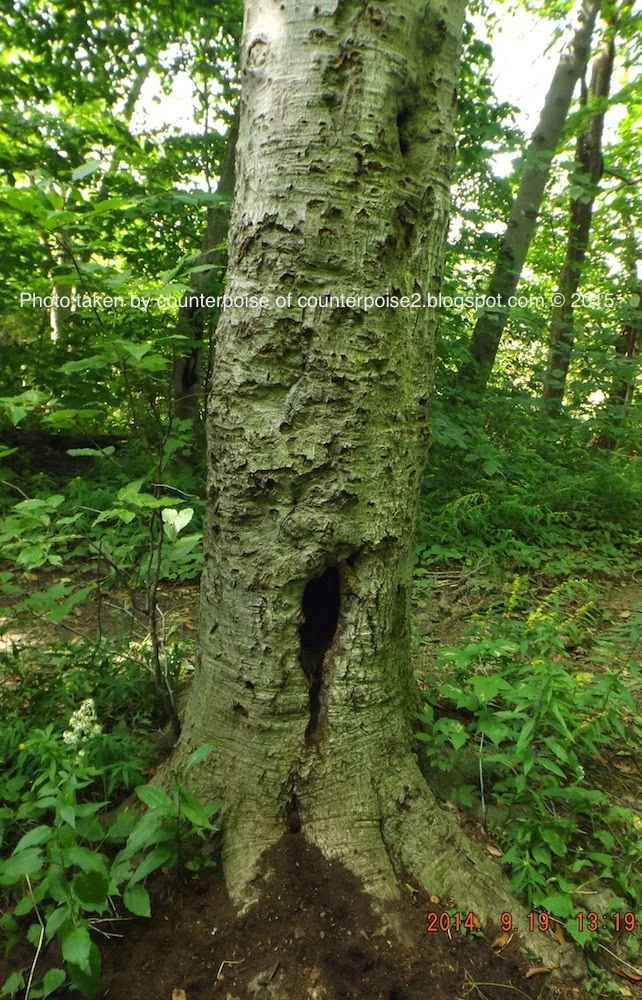
Tree, London, Ontario, September 19, 2014
D.          The "Body, Mind & Spirit" interview with Calvin Helin, October 1, 2014.  Host Patricia Kennedy and co-host Leith Peterson

"Body, Mind & Spirit" is a CHRW 94.9 FM radio show at Western University in London, Ontario.  The show airs three times a month, and the host is registered nurse, Patricia Kennedy.  The show "explores holistic medicine, practitioners, research, health issues and more."  Around late August 2014, Kennedy asked me if I would be willing to appear on the show, to discuss the book I am working on, which is about my two generations of experience with aboriginal issues.  I told her I was declining interviews until my book is hopefully published.  However, I suggested that she consider speaking with Calvin Helin about his book Dances With Spirits.  This is because I thought many of the issues he discusses related well to her show's theme.

Kennedy said my suggestion was good, as long as I agreed to be co-host.  Helin agreed to be interviewed by Kennedy and me on October 1, 2014.  There is a permanent link to the show audio at thermographylondon.com  Go to "Shows & Events," then "Body, Mind & Spirit," then October 1, 2014.  Or go to "Blog," then October 2, 2014.

There are a number of technical glitches during the first 20 minutes or so, but all the people I have spoken with, who have listened to the approximately 57-minute broadcast, say they were glad they heard it.  Quite a few said they planned to read Dances With Spirits, and some also spoke of checking out some of his other books.

If you decide to listen, I apologize in advance for my poor delivery, particularly during the first part of the show.  Had extensive training at college and university regarding how to properly present myself verbally, but all that accumulated knowledge escaped me the morning the show was recorded.  Will endeavour to do better if I ever have to do anything like this again.

Bibliography

Cairns, Alan C.  Citizens Plus: Aboriginal People and the Canadian State.  Toronto: UBC Press, 2000.

Council of Reference - Ways.  Fanshawe College Canadian Studies Native Peoples I - Ways of Wisdom [course handout, unpublished].  Fanshawe College Native Studies, ca. 1971-1974.

Grant, Tavia.  "New alarm bells over household debt as Canada faces 'downward spiral.'"  Globe and Mail, February 5, 2015.

Helin, Calvin.  Dances With Dependency: Indigenous Success Through Self-Reliance.  Vancouver: Orca Spirit, 2006.

Helin, Calvin.  Dances With Spirits: Ancient Wisdom for a Modern World.  Los Angeles: Premier Digital, 2014.

Helin, Calvin.  The Empowerment Mindset: Success Through Self-Knowledge.  Los Angeles: Premier Digital, 2012.

Jacobs, Mindelle.  "First nations, last place: Chiefs and councils keep bands dependent, says author." Edmonton Sun, November 17, 2010.

McClocklin, Jim.  Charles T. Peterson [eulogy, unpublished].  April 4, 2007.

Peterson, Jay.  Phase Five: Experiencing Equality [seminar, unpublished].  University of Western Ontario, Department of Occupational Therapy, March 1975.

Rollason, Kevin.  "Native lawyer slams aboriginal welfare."  Winnipeg Free Press, January 21, 2011.

Van Brenk, Deborah.  "The number of distracted driving tickets handed out by London police keeps going up - as is the number of collisions in the city."  London Free Press, January 28, 2015.

Vancouver Sun.  "Enormous opportunities seen for first nations entrepreneurs."  April 6, 2011. 

Sunday, 2 February 2014

A Review of Some Aspects of the Blog "Six Nations (Haudenosaunee) & The Haldimand Tract: Beliefs Versus Facts"

Disclaimer: My references to the writings of other people--both native and non-native--do not in any way imply that they share my views on this matter.  The opinions expressed here are my own, and do not necessarily reflect those of my family, friends or associates.

Background Information Regarding Deyo and His Blog

On October 31, 2013, a resident of Haldimand County in Southwestern Ontario, Canada, started a blog entitled "Six Nations (Haudenosaunee) & the Haldimand Tract: Beliefs Versus Facts" (deyoyonwatheh.blogspot.ca).

I recently became aware of his blog through some online searching, and have read all of his (as of this writing) 80 posts.  He signs each of his entries with "DeYo," so that is what I will call him.  When I quote from or reference his posts, I will put in a notation at the end that will include a key word or words from the post title, the date of the post and the post number in sequence from 1 to 80.  (The post numbers are not included on the blog itself; I have just added them in for my own reference.)

DeYo's "kinship connections include, among others, the people of Haldimand County, the Delaware of Smoothtown, and the Lower Mohawk of the old Mohawk Village and Tyendinaga."  (Although he has aboriginal ancestry, he does not live in an aboriginal community in Haldimand County.)

From his early life onward, he has been aware of "unresolved land disputes" between the Six Nations (Haudenosaunee) and the Canadian federal government (as successors to the British Crown).  He "tended to focus on what the evidence would clearly show to be true" ("Genesis," October 31, 2013, #1).

For more than 30 years, he has examined not only "specific relevant documents" related to the Six Nations (SN) land claims, but also "related records, and the diaries and letters of Indian Department officials. . ." ("Surrenders. . .1841-1850," November 8, 2013, #30).

His research into the SN claims primarily took place over a 20-year period "between the mid 1970s and mid 1990s."  He reviewed records at Library and Archives Canada, the Archives of Ontario, The Library of the Woodland Cultural Centre, the Brant County Library, and the Haldimand County Museum and Archives.  In addition, he has scrutinized the 29 claims listed on the SN Lands and Resources website ("Examination. . .29 claims," December 21, 2013, #57).

Some of the Main Reasons Why DeYo Started His Blog

1.   The Caledonia, Ontario crisis, which started on February 28, 2006.  He says SN has no legal right to be claiming the land at the "south end of Caledonia," and he has the historical documentation to prove it.  He notes that "2006. . .was to see my world and that of those around me change forever. . .among other things, I realized there was a huge psychological gap between many of the Six Nations residents and the 'townsfolk' in for example nearby Hagersville, Caledonia and Brantford."

2.   Fallout from the Ipperwash "incident."  He observes that because of this "incident," the Ontario Provincial Police [OPP] "went from elite to effete, and their leadership became enablers. . .the rule of law vanished as the area degenerated into anarchy."  He suggests if people want to learn more about the suffering of the local non-aboriginal residents that they read Christie Blatchford's Helpless: Caledonia's Nightmare of Fear and Anarchy, and How the Law Failed All of Us (2010). 

3.   Blockade of Highway 6, by some SN protesters, October 17, 2013.  DeYo got stuck in this blockade, and it became one of two triggers that led to the creation of his blog.

4.   McKenzie Meadows Project article in "local Native paper," October 30, 2013.  After he read this article, he feared the "whole problem (questionable land claims and fallout) would never go away," so this became his second trigger ("Genesis," October 31, 2013, #1).

DeYo and Gary McHale: Six Nations are Not Indigenous to the Haldimand Tract 

The conclusion DeYo has come to is that many of SN's 29 claims are based on "unsupported, unvalidated and patently false" information.  Two key documents that he says prove his assertion are a 2009 report prepared for the City of Brantford (the "Holmes report"), and a ent," December 24, 2013, #64; "False," January 18, 2014, #77).

DeYo is not implying in any way that claims put forward by other Canadian aboriginals are lacking in merit; that is beyond the scope of his research.  He says there are problems with the SN claims because the SN are not indigenous to the Haldimand Tract.  He explains how the Crown purchased the land the Six Nations are currently on from the Mississauga:
The Five Nations did exterminate the Huron/Wyandot, Petun, Attiwandaronk, Erie and other peoples of Southwestern Ontario. . .in the mid 1600s.  Thus they removed by conquest all of the former occupants of Southwestern Ontario, leaving it a human desert for a number of years.  However, Mississauga (Ojibway/Chippewa) peoples soon began to move into the area and establish settlements or at least territorial rights. . .By 1696, the Three Fires Confederation had destroyed all but three settlements of the First Nations and they had no presence at all there by 1700.  The Three Fires Confederacy was composed of the Mississauga, Ojibway and Pottawatomi. . .In the end, the land was left to the Mississauga who were the acknowledged "owners" of Southwestern Ontario, and from whom Governor General Sir Frederick Haldimand purchased the Haldimand Tract for Six Nations occupancy in 1784.
Hence when the Nanfan Treaty of 1701 was signed by 20 representatives of the Five Nations (the Sixth Nation, the Tuscarora, were not incorporated until about 1714), they were yielding their "beaver hunting grounds" in Southwestern Ontario to the British - however, they had no claim to Southwestern Ontario because they had been totally defeated by the Mississauga and their allies ("Treaty," January 17, 2014, #75).
He explains that the Six Nations:
. . .were dispossessed Loyalist refugees looking for a suitable place to settle.  When Captain Joseph Brant chose the Grand River lands, it was necessary for the Crown to purchase the lands from the rightful owners - the Mississauga.  It was widely known that the only claimants to these lands at that time were the Mississauga. . .

. . .When Governor Haldimand was faced with the task of accommodating the thousands of Six Nations and other Native peoples who had fought for the Crown, and whose aboriginal properties in NY had been utterly destroyed by the depredations of the American General Sullivan, he obtained a deed of sale from the Mississauga who owned the entire region by right of conquest dating to the closing years of the 1600s. . .

. . .The Six Nations are aboriginal to the area between the mouth of the Mohawk River to the Finger Lakes and beyond towards Lake Erie.  However, these lands do not belong to the Crown any longer, and so the Six Nations are no more aboriginal to the Haldimand Tract than their fellow Loyalists and military comrades. . .("Six Nations are NOT Aboriginal," November 2, 2013, #6).
Caledonia activist, Gary McHale, covers some of the same ground as DeYo in his book Victory in the No-Go Zone: Winning the Fight Against Two-Tier Policing (2013; 186-187).  For instance, he says ". . .despite the impression given by the OPP, government and media, Six Nations are not First Nations.  They have no signed treaties with the Canadian government, and no basis under which to make a property claim" (187).

Thomas King's Questionable Comments on the Caledonia Crisis in The Inconvenient Indian

The information provided by DeYo, McHale and Blatchford makes me question even more some statements made by Cherokee/Greek author, Thomas King, in his book The Inconvenient Indian (2012).  King describes Blatchford's Helpless as a "sloughing off of history. . .style of scholarship."  He also contends that the Canadian and Ontario governments have "ignored and dismissed. . .the long-standing native land claims dating back to the 1700s," and implies this contributed to the Caledonia crisis (165-166).

In addition, King takes aim at the Ontario government for settling a $20 million lawsuit with some non-aboriginal Caledonia residents in 2011.  He implies this compensation may have been politically motivated, since a provincial Liberal election occurred a few months after the settlement.  There is ample justification for concluding that it was indeed politically motivated.  But I am shocked that he then claims this settlement shows that "[t]he concerns of the Mohawk and the land claim itself were shoved into a closet. . ." (175-176).

It seems to me that, since historical evidence demonstrates that SN have no right to be claiming certain areas, including land at the south end of Caledonia, then Ottawa and the Ontario government would be in a difficult position to resolve the matter.  It also seems to me that, if anything, the Ontario government, in particular, has gone overboard to appease SN regarding certain claims.

Conclusions

DeYo summarizes his concerns as follows:
To expect meaningful change to happen without resistance is unrealistic.  What I do hope is that those with the power to act, will show some respect for the data and the facts - and respond accordingly with some backbone.  My greatest trust is in the Courts.  It is here where we can find true justice in Ontario, free of the taint of politics ("Recent," December 24, 2013, #64).
If DeYo is wrong in his assertions, then the parties in question need to provide the necessary data to prove this is the case.

Afterthoughts

I agree with many of the statements DeYo makes in his 80 blog posts, but I feel he sometimes generalizes too much.  I believe this is because most of his interactions with aboriginals have involved Six Nations, and have ended up being negative.

I have also had some negative interactions with aboriginals, as explained in some of my previous posts on this blog.  However, I have also had some positive experiences, and am optimistic that things are getting better in certain areas.

For instance, I have been heartened by many of the aboriginal success stories that have been presented on the Sun News Network by commentators such as Ezra Levant.  Although Levant is one of the aboriginal communities' biggest critics (and has a tendency to exaggerate), I hope he continues to provide coverage of when aboriginals do well. 

A growing number of native reserves thrive as collectives because they have shaken off the cloak of dependency on government funding, have taken personal responsibility for their actions, and have moved forward with viable and self-sustaining action plans.

As I explained in my "Canadian Aboriginal Integration. . ." post, "I remain firmly on the side of those aboriginals who agree that maintaining their Canadian citizenship is a good thing."  I do not have a problem with aboriginal rights that have resulted from Canadian Constitutional provisions, as long as these rights do not harm aboriginals or non-aboriginals, e.g., traditional practices among some tribes that condoned violence and disparaged women.  I favour an aboriginal governance model that allows for integration with the Canadian government system.  In other words, I do not agree with natives creating separate nation states outside of the Canadian Constitution.

(In addition, I totally support those aboriginals who do not want to remain as part of collectives on reserves or in urban areas, and who wish to become part of mainstream Canada.  There are thousands who have chosen this route.)

I believe the Six Nations are lagging behind other communities in terms of effective governance because of their complex history and community dynamics.  As DeYo has pointed out, and as I have read elsewhere, there are some Six Nations members who realize the reserve situation could use some improvement.  For those who feel this way, I highly recommend Tsimshian author/entrepreneur/lawyer, Calvin Helin's, The Empowerment Mindset (2012).  The sub-section of Chapter 2, entitled "Community- and Group-Conditioned Negativity" (38-41), is particularly relevant.

Monday, 21 May 2012

Caledonia and Six Nations: Majority Opposed April 28, 2012 "Parade"

The Grand River land dispute includes 40 hectares in Caledonia.  Caledonia is located in Haldimand County, in Southern Ontario.  Henco Industries originally planned to build a residential subdivision, to be called Douglas Creek Estates (DCE), on this land.  But some aboriginals at the Six Nations reserve claimed that this land was never surrendered and started an occupation there on February 28, 2006; the occupation continues to this day.  The federal government maintains that the land was properly surrendered in 1841, and sold in 1844.  The Six Nations elected council agrees with the government's contention, but maintains there should be "fair compensation."  However, the Haudenosaunee Confederacy (traditional) Council asserts that the signatories to the sale were deceived (Blatchford, p. 27).  Toby Barrett, the Haldimand-Norfolk Conservative MPP, stated in a February 29, 2012 news release that "there are a number of valid land claims along the Haldimand tract area but not on Douglas Creek Estates."  On the sixth anniversary of the standoff, Barrett announced that Haldimand County had lost 650 residents partly because of the "dismal economic conditions locally and the erosion of justice, rule of law and democractic process" that have resulted from the occupation of the former DCE.
Many of the best recommendations for improving the aboriginal situation originate with natives who recognize that changing things for the better is a two-way street.  They acknowledge that all the blame for native woes cannot be placed on non-natives' shoulders.  Tsimshian lawyer and entrepreneur, Calvin Helin's, book Dances With Dependency (2006) is filled with numerous insights that I share.  Cree Don Sandberg wrote lots of excellent articles for his former employer, the Frontier Centre for Public Policy, and continues to write ground-breaking pieces for media outlets like the Winnipeg Free Press and National Post.  Helen Miller, a Six Nations elected band councilor, has had a couple of her powerful letters published in the Brantford Expositor and Turtle Island News.

But I also believe that non-aboriginals have a role to play in recommending solutions.  In my case, I am speaking from two generations of experience dating back to the late 1950s, and as someone who worked in aboriginal organizations in different parts of Canada for about 12 years.  And Sandberg believes people like me should speak out.  In a January 2, 2011 National Post article, he was asked his opinion as to what should be done about aboriginal accountability problems.  He responded with "[t]he strongest voice aboriginal reformers have is the non-aboriginal taxpaying public, who can let their elected officials know something has got to be done.  Because we know the government itself does not listen to grassroots native people."

Fortunately, at Caledonia and Six Nations, many aboriginals and non-aboriginals found common ground in their opposition to an outrageous April 28, 2012 "parade" through Caledonia, orchestrated by a group of mostly non-natives from other parts of Southern Ontario.  One of the parade organizers was Tom Keefer who has been involved with the DCE protests since April 20, 2006.  Caledonia activist Mark Vandermaas described Keefer and his allies as a "gang of anarchists, Marxists, radical unionists, and anti-Israel groups who have been supporting the lawlessness in Caledonia since nearly the beginning."  

http://voiceofcanada.wordpress.com/2012/04/27/dear-caledonia-residents-about-tom-keefer-tomorrows-takeover-of-caledonias-streets/

A media release issued by the march organizers said that participation included representatives from Six Nations as well as non-natives from eight Southern Ontario cities, and that as many as 1,000 could be expected (Day, Dunnville, April 18, 2012; Gamble, Brantford April 27, 2012).

Although local and regional news outlets in the Caledonia area paid considerable attention to the discussions before, during and after the march, it received virtually no coverage outside of those areas.  But I think it is important to draw attention to it because it is a very encouraging development.

I first learned about the march through some correspondence I received from Canadian Advocates for Charter Equality (CANACE) Executive Director Gary McHale and Caledonia Victims Project Founder Mark Vandermaas.  Both activists said their groups would not be present at the march because they did not believe in interfering with events initiated by natives.  However, McHale and Vandermaas did organize a protest the week before, on April 21, at which Vandermaas and another Caledonia activist Jeff Parkinson were arrested.  You can read about their unwarranted detainments at the following links:

http://caledoniawakeupcall.wordpress.com/2012/04/24/video-two-arrested-for-race-in-caledonia/

http://voiceofcanada.wordpress.com/2012/04/27/vandermaas-email-to-opp-officer-re-april-21-dce-rally-before-two-breach-of-peace-arrests/

Haldimand County Mayor Ken Hewitt made it clear he did not agree with the April 28 "parade" in his April 3, 2012 article in the Sachem.  He said "[f]or most of us who live here, we need not be reminded of the time that has elapsed when assessing the absolute abysmal failure of government.  We do not need people coming from other regions to parade through our community in order to satisfy their personal agenda."

Dr. David K. Faux, a Caledonia resident whose maternal ancestry includes a Six Nations Mohawk clan mother, also raised concerns about the march.  In his April 10, 2012 letter to the Sachem, he said that the '''parade' is a euphemism for 'protest march.'"  He went on to say that the "'parade' organizers have an agenda and we (collectively known as 'settlers') are to be at the receiving end of their anti-establishment aims and aspirations.  DCE is just a matter of convenience to them."

Six Nations elected Chief William Montour was not able to get a resolution passed through his 12-member council opposing the march, but he said his feeling was that "our people are starting to get over 2006" and that the march could "create havoc" (Vo, Sachem, April 17, 2012).

The day before the march, Vandermaas sent an email to his Caledonia mailing list, in which he said:
Tomorrow the people who terrorized your town and those who support them will march in a propaganda effort to convince the victims they created to submit to their twisted logic that you are responsible for the violence against you and your town.
In this post, he also made reference to a July 14, 2009 letter that Helen Miller wrote to the Brantford Expositor, in which she said that certain groups at Six Nations, such as the Mohawk Warriors, "were not elected, appointed or authorized by the people of Six Nations to be their representatives or to speak on their behalf."

http://voiceofcanada.wordpress.com/2012/04/27/dear-caledonia-residents-about-tom-keefer-tomorrows-takeover-of-caledonias-streets/

There were other aboriginal and non-aboriginal people who spoke out against the march.  If you want to read more about it, you can refer to the bibliography below.

Although the parade organizers announced ahead of time that 1,000 people could be expected, only about 400-500, most of them non-natives, actually showed up (Wong, Spec, April 28, 2012; Pearce and Day, Dunnville, April 29, 2012; Pearce, Dunnville, April 29, 2012).

At the event, Faux carried a sign that stated in Mohawk and English "that 98 per cent of Six Nations and Caledonia want nothing to do with the march."  In his May 9, 2012 letter to the Spec, he said:
The sea of Palestinian, Black Panther, Communist Party of Canada and CUPE flags (what is my former union doing with its members' wages?) give an excellent indication as to who was at the march.  As someone with a foot in both the Caledonia and Six Nations communities, I will proposing a new approach to dealing with the problem since the folks in Ottawa seem to be a bit tardy in getting on with land claims negotiations.
I hope that Faux succeeds.  I think he will be building on the work of Caledonia activists, such as McHale, Vandermaas and Parkinson, who laboured for years, often suffering taunts and abuse, before they started to get some recognition from the media and general public.

The mixture of aboriginal and non-aboriginal opposition to the April 28, 2012 march also signals that many residents of Caledonia and Six Nations realize they need to come up with their own solutions.  I am greatly relieved to hear this.

Bibliography

Barrett, Toby.  "Occupy Caledonia will be six years February 28,"  February 28, 2012.  <tobybarrett.com>

_____.  "There is no valid claim on DCE."  February 29, 2012.  <tobybarrett.com>

Blatchford, Christie.  Helpless.  Toronto: Doubleday, 2010.

Day, Matt.  "Caledonia reacts to peace walk." Dunnville Chronicle.  April 29, 2012.  <dunnvillechronicle.com>

_____.  "No injunction for Caledonia rally organizers."  Dunnville Chronicle.  April 18, 2012.  <dunnvillechronicle.com>

_____.  "Planned Caledonia rally has Hewitt upset."  Dunnville Chronicle.  April 13, 2012.  <dunnvillechronicle.com>

_____.  "Two arrested during CANACE rally Saturday."  Dunnville Chronicle.  April 23, 2012.  <dunnvillechronicle.com>

Faux, David K.  "Caledonia march is opposed by mayor, chief" [Letter].  Hamilton Spectator.  May 9, 2012.  <thespec.com>

_____.  "'Parade' euphemism for 'protest march'" [Letter].  Sachem.  April 10, 2012.  <sachem.ca>

Foot, Richard.  "Reserves look within for fix to accountability problems."  National Post.  January 2, 2011.  <nationalpost.com>

Gamble, Susan.  "Thousands expected for Caledonia peace march."  Brantford Expositor.  April 27, 2012.  <brantfordexpositor.ca>

Helin, Calvin.  Dances With Dependency.  Vancouver: Orca Spirit, 2006.

Hewitt, Ken.  "Hewitt: DCE a quagmire."  Sachem.  April 3, 2012.  <sachem.ca>

 _____.  "What's April 28 march really about?"  Sachem.  April 17, 2012.  <sachem.ca>

Miller, Helen.  "Only elected council can speak for Six Nations" [Letter].  Brantford Expositor.  July 14, 2009.  <brantfordexpositor.ca>

Parkinson, Jeff.  "Video--Two arrested for race in Caledonia."  April 24, 2012.  <caledoniawakeupcall.wordpress.com>

Pearce, Daniel R.  "Hundreds take part in Caledonia peace march."  Simcoe Reformer.  April 29, 2012.   <simcoereformer.ca>

Pearce, Daniel and Matt Day.  "Caledonia reacts to peace walk."  Dunnville Chronicle.  April 29, 2012.  <dunnvillechronicle.com>

Vandermaas, Mark.  "Dear Caledonia residents--about Tom Keefer. . ."  April 27, 2012.  <voiceofcanada.ca>

_____.  "Email to OPP officer re April 21 DCE rally before two 'breach of peace' arrests."  April 27, 2012.  <voiceofcanada.ca>

Vo, Jennifer.  "Coalition planning April parade in Caledonia."  Sachem.  April 3, 2012.  <sachem.ca>

_____.  "Parade rubbing salt in old wounds says Chief Montour."  Sachem.  April 17, 2012.  <sachem.ca>

Wong, Danielle.  "Friendship walk peaceful, but Caledonia residents fear wounds reopened."    Hamilton Spectator.  April 28, 2012.  <thespec.com>

Monday, 5 September 2011

Aboriginal Issues During the "Culpability Era"

The definition for "cultural relativism" is "the principle that an individual human's beliefs and activities should be understood by others in terms of that individual's own culture" (Wikipedia, August 13, 2011).

The "critical race theory" definition for "white privilege" is "a way of conceptualizing racial inequalities that focuses as much on the advantages that white people accrue from society as on the disadvantages that non-white people experience" (Wiktionary, June 17, 2010).

The definition for "culpability" is "the degree of one's blameworthiness in the commission of a crime or offense" (Wiktionary, August 23, 2011).

People often ask me how I got involved with aboriginal issues in the first place. The truth is that aboriginals and their supporters recruited me to work for them. To make a long story short, some of my family's involvement with native issues (dating back to the 1950s) probably made the recruiters think I was a good candidate to help them with their "cause." In fact, a couple of recruiters actually showed up at one of my former places of employment (in a mainstream institution) and urged me to work for them. Bear in mind, though, that this was back in the 1970s, when there were not as many aboriginals with skill sets that the native organizations needed. I also suspect that, in order to get certain funding, the people in charge had to show that they had qualified people to do the work, so my college diploma and related experience fit the bill for that. In addition, the recruiters wanted me to train native people--something I did a lot of when I worked in this area.

However, I am an opinionated individual, and that fact, combined with my white skin, did not always fit in with the collectivist mindset that operated in these places. In retrospect, I should have left at the first sign of trouble, but two major factors kept me involved. The first was that an aboriginal woman very likely contributed to saving my life in the early 1970s. She died in the early 1980s--far too young and under tragic circumstances. Second, a family member who was very much involved with the aboriginal scene passed away when I was working in the organizations. Both these factors made me feel that I had an obligation to support the aboriginal cause, and this obligation propelled me through about 12 years in the organizations. I now realize that I should have got involved because I was truly motivated, not because I felt I had to.

Up until the late 1980s, I assumed that my problems in this area were because I was an opinionated white who just did not "get it." But the extensive reading and reflection I have done since then have made me understand that the explanation is much more complicated than that. I now realize I was involved in what I will refer to as the Cultural Relativism Era. The proponents of the cultural relativist movement I was part of believed that aboriginal woes could be resolved if natives returned to their traditional ways. I see this era as beginning after the release of the Trudeau government's 1969 White Paper and the aboriginal response: the Red Paper. From the 1970s onwards, aboriginal groups repeatedly asked for and often got more government funding.

The main point of establishing the organizations was to help aboriginals gain greater self-determination, e.g., in relation to land rights and governance. And to a certain extent, greater self-determination has been the result. For instance, I am pleased that the training I did with some aboriginals helped them to further their education and work prospects.

But natives had a lot of cards stacked against them before they even got started setting up their agencies in Canada. I believe many of the resultant problems were based on the rocky relationship that had existed between the races for more than 300 years. One prominent example of this is the , which is still in effect today. Until 1985, Status Indian men could marry non-aboriginal women and the women would gain status, but the same did not hold true for Status aboriginal women marrying non-aboriginals or non-Status Indians. I believe this provision has done a lot of damage to relations between the sexes, both aboriginal and non-aboriginal. When I was working in the organizations, I did not fully understand how the Indian Act system worked, but now that I have had a chance to examine it in more depth, I realize it was very detrimental, particularly to aboriginal/non-aboriginal female relations.

I know from working for many years in mainstream institutions that office politics play a role in workplace dynamics. Let's face it: whenever more than two people get together in a work setting, there are bound to be differences from time to time. But I found the possibilities for conflict were greatly intensified with the race card thrown into the mix.

After I stopped working in the organizations in the late 1980s, I planned to return to the mainstream. But just as I was embarking on my new life path, some politicos dragged me back into the aboriginal fray by publicly spreading false accusations about me. As a result, I was viciously harassed and subjected to the devastating effects of bad medicine--I was used as a sacrificial lamb.

When the worst of the harassment was over, I tried to convince myself that the sacrificial lamb period was behind me. I was also hopeful that people sympathetic to my plight would assist me on my road to healing and reconciliation. But I discovered, after many years of trying, that even aboriginals and their supporters who had been closely associated with me for decades only paid lip service to my desire for justice. I concluded that the doctrine of white privilege was often strictly adhered to in aboriginal country. But it was even more upsetting for me to learn that this doctrine was also firmly ensconced in many academic, religious, and political institutions that I had to deal with for one reason or another. Even though it was usually not expressed in such blatant terms, the underlying message I got was "healing is for aboriginals; white people are just supposed to take it."

The Caledonia crisis, which started in February 2006, and which still reverberates to this day, made me realize that white privilege was not only affecting me, but also other non-aboriginals. I have already covered this topic in my "David Peterson and the Caledonia Crisis" post. I am also alarmed by the fact that the Ontario government's Ipperwash Inquiry Report (2007) paid almost no attention to the concerns of the non-native residents, even though some of these residents made presentations to the inquiry. I think taxpayers deserved more bang for their buck than they got with the $27+ million Ipperwash Inquiry.

I believe the Caledonia crisis (and other native occupations and problems, such as contraband tobacco smuggling) made many members of the public recognize that the governments' appeasement strategies were not working very well. And I contend that this growing awareness signaled the dawn of a new era in 2006, which I will call the Culpability Era.

Tsimshian lawyer and entrepreneur, Calvin Helin's, book Dances With Dependency, was also released in 2006; I believe his book substantially contributed to the move into the Culpability Era. Helin argues that aboriginal welfare dependency should be replaced by "self-reliance." He strongly believes in aboriginal cultural preservation, but he asserts that aboriginals should not be dependent on government funding to make this happen; they should develop alternative sources of revenue, e.g., from natural resources.

Helin believes that certain provisions of the Indian Act give far too much power to the chiefs and council. For example, only the chiefs can elect the Assembly of First Nations (AFN) national chief. Although there have been attempts by some aboriginal spokespeople to change the AFN rules so that voting rights are extended from just the chiefs to band members, (in fact, some have lobbied for voting to be extended to urban aboriginals), none of these attempts have been successful. In the last AFN election in July 2009, John Beaucage ran on a universal voting platform and only received 15 per cent of the vote on the first ballot.

Don Sandberg, a Cree who is president of Nistanan, "Canada's first aboriginal policy think tank," says that aboriginals need more leaders with "education, drive and imagination." He feels the reason why chiefs often vote against necessary reforms is because they are afraid to take risks. I agree with Sandberg's assessment, and I hope a greater number of aboriginals heed his advice.

Although many non-aboriginal Canadians are concerned about the native situation for one reason or another, they often prefer to stick their heads in the sand in the hopes that the situation will improve on its own. And it likely will get better as long as people like Helin and Sandberg continue to speak out. But it will improve a lot more quickly if non-aboriginals, particularly federal, provincial and municipal leaders, start to look at how their own views are contributing to the problem. Citizens can help improve government policies by making their concerns known to their elected representatives.

The outmoded cultural relativism and white privilege doctrines contribute to appeasement strategies that ultimately do not help either side of the equation. If culpability is first established, then constructive solutions are more likely to follow.

Notes

• Both Helin and Sandberg have addressed the fact that intimidation and harassment are sometimes used by aboriginals in positions of power in order to maintain their power base. 

• A colleague recently made me aware of the writings of some aboriginal women who state they have been rebuked by aboriginal males and females if they deviate from the standard positions held by some aboriginal elites.  They have been accused of being sellouts, and have sometimes suffered professionally.

• The above factors could explain why some natives refused to side publicly with me, although I can't be sure. 

For Further Information

Aboriginal Reserve Governance

• Curry, Bill. "Big Influences, Tiny Reserves," Globe and Mail, August 13, 2009 <www.globeandmail.com>

Caledonia Crisis

• Caledonia Victims Project
• Caledonia Wake Up Call
• International Free Press Society-Canada
• Jeff Parkinson
• Voice of Canada

Helin, Calvin

Dances With Dependency. Vancouver: Orca Spirit, 2006.

Ipperwash Situation

• Voice of Canada's "Caledonia and Ipperwash Resources"

Sandberg, Don

• "Wanted: Productive Native Reserves," National Post, October 7, 2010 <www.nationalpost.com>